





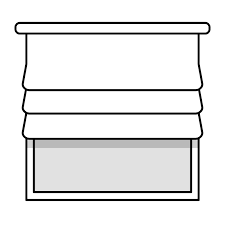
Roman blind Product Sheet
Roman blinds are the most elegant of window blinds. The perfect compromise between heavy curtains and slim-line roller blinds, Roman blinds offer a cosy, homely feel in a more compact and versatile way. Roman blinds are constructed from mounting slats, cords and a fabric panel that is designed to pleat when raised. The beauty of a Roman blind is your ability to lower it to a specific point, so it will always look stylish while you can enjoy privacy and light control.
OPERATION
When the blind is opened, the cords pull the slats together and force the fabric into pleats. When closed, the cords release the slats and allow the fabric to relax.
MATERIALS
Fabrics that have a lot of give (slightly stretchy) will not tend to remain flat after some use. Depending on the width of the blind there may be a join(s) in the fabric. This is typically not applicable for blinds less than 135 cm wide.
With multiple blinds, the pattern on the fabric may not match adjacent blinds and may not be centralised on the blind.
Very large blinds that are made using a plain fabric will show more stitching/construction than patterned fabrics.
Roman blinds can either be machine sewn giving rows of stitching through which light will penetrate, or stab stitched which gives only the occasional pin-prick of light. Any light penetration will be more obvious with darker/opaque/blackout fabrics. Standard linings may allow the stiffeners (rods) to be visible as a shadow when the blind is lit from behind. Blackout linings or bonded blackout help prevent this, but any stitching which penetrates the fabric will show up as pin-pricks of light
INSTALLATION
When fitted in a bay window, there will be some gaps where the neighbouring blind headrails meet each other. The size of any gap will depend on several factors including; the shape of the bay, the style of the window and the specification of the blind system.
Similarly, at the edge of the bay there may be light gaps/potential loss of privacy depending on the angle of the bay and the adjoining walls.
Roman blinds in bay windows may see the fabrics of front and side blinds touching when the blind is operated. In a bay, blinds are typically made to the same maximum drop, so some blinds may rest more heavily on the sill than others.
Fitting inside the reveal (window recess) To fit the blind, there will be a gap between the edges of the blind and the walls of the reveal for operating clearance. If there are any obstructions in the reveal, for example tiles or a dado rail, the blind will need to be made to the narrowest width, so outside the obstruction there will be a bigger gap between the blind and the reveal. The length of the blind is normally made to the maximum drop so the fabric may sit heavy on the sill if it is not level.
Reveal (recess) not dimensionally consistent
Roman blinds are made square, however in reality reveals are often not. The head of the window or sill may not be level and the distances between the side walls throughout often vary.
The distance from the edge of the reveal to the window may also vary, so blinds will either be fitted to run parallel to the window or to the edge of the reveal.
Blind Stack
When roman blinds are fully raised, the folds of fabric will cover the top portion of the window. The amount covered and how far the stack of folds protrude into the room are dependent on the height of the window and the construction of the blind.
Roman blinds may not naturally fold into panels when raised, particularly those in bay windows, and they may therefore require some dressing by hand.
Dim-out
Roman blinds with opaque fabrics/linings provide a good degree of dim-out but there will be light coming around the extremities of the blind and possibly through the stitching.
This is more apparent with blinds fitted inside a reveal than those fitted outside.
MAINTENANCE
Cleaning: The way you clean your Roman blind will depend on the type of fabric, as all fabrics come with different cleaning advice. If you are ever unsure, make sure you consult a professional so that you don’t risk ruining the fabric.
The majority of the time, it’s easy to keep your Roman blind looking and functioning well with some regular light cleaning. To remove dust and dirt, use the soft brush attachment and lowest setting on your vacuum cleaner. Open your Roman blind and brush the front gently from top to bottom, concentrating on the edges of the fabric, which tend to collect more dust. Do not vacuum the back of your Roman blind as cords can tangle.
If your Roman blind chains or cords are stained, you can clean them with baby wipes. For the mechanism, use a simple silicone spray and soft cloth, which will remove dirt and prevent squeaking or stiffness.
Since Roman blinds are made from soft fabric, stains can be difficult to remove. Avoid stain removers on the fabric as they can lead to discolouration. Instead, try baby wipes, which are very effective at removing stains. If your Roman blind is made from silk or faux silk, you should not attempt to clean it at all – instead, seek advice from a professional.
Soft fabrics are also susceptible to absorbing household smells, especially if your Roman blind is located in or near the kitchen. To get rid of unpleasant odours, try removing the blind and laying it on a flat surface, then sprinkling with baking soda. After 24 hours, any smells should have been absorbed, and you can vacuum up the baking soda on a low setting.
MOTORISATION
There is a wide range of motorised solutions available for your comfort and convenience and each system will have its own characteristics. Some points to consider are:
Speed and alignment:
Blinds in the same installation may not travel at the same speed and may not line up if stopped during the travel of the blinds due to mechanical and electrical tolerances.
Noise:
Being operated by a motor, some noise will be emitted. Quiet motors may be available.
Wiring:
Some surface wiring may be required. Where 240V mains power is involved, a competent person will be required to provide a power feed unless the blinds can be powered from a plug inserted into an existing socket.
Motor protection:
For safety reasons, most motors are fitted with a thermal cut-out to protect them from getting too hot (usually from over-use). When cooled sufficiently, the motor will start working again.
SMART HOME HUB
Where a smart home hub is used the signals to the blinds may get occasionally interrupted by other wireless devices in the home such as smart speakers or doorbells. This can affect the operation, or seamless operation of the blind.
CHILD SAFETY
Where a smart home hub is used the signals to the blinds may get occasionally interrupted by other wireless devices in the home such as smart speakers or doorbells. This can